On World Environment Day, the words spoken in defence of the planet almost always outnumber the actions that follow. If even a fraction of those speeches turned into work done by ordinary citizens, the earth would already be a far better place to live. This year, in a small town in Madhya Pradesh, a community decided to swap the speeches for shovels — and the result is worth telling.
A 200-year-old lake, choking quietly
Maharaj Sagar — known locally as Daram Sagar — is one of the most significant historical water bodies in Panna town. It dates back to the 18th century and the era of the Bundela dynasty. For generations it has done quiet, essential work: recharging groundwater, supporting irrigation, and supplying drinking water to the town around it. Ponds and lakes like this are not ornamental. In small towns they are the lifeline of the water supply and the anchor of a balanced micro-environment.
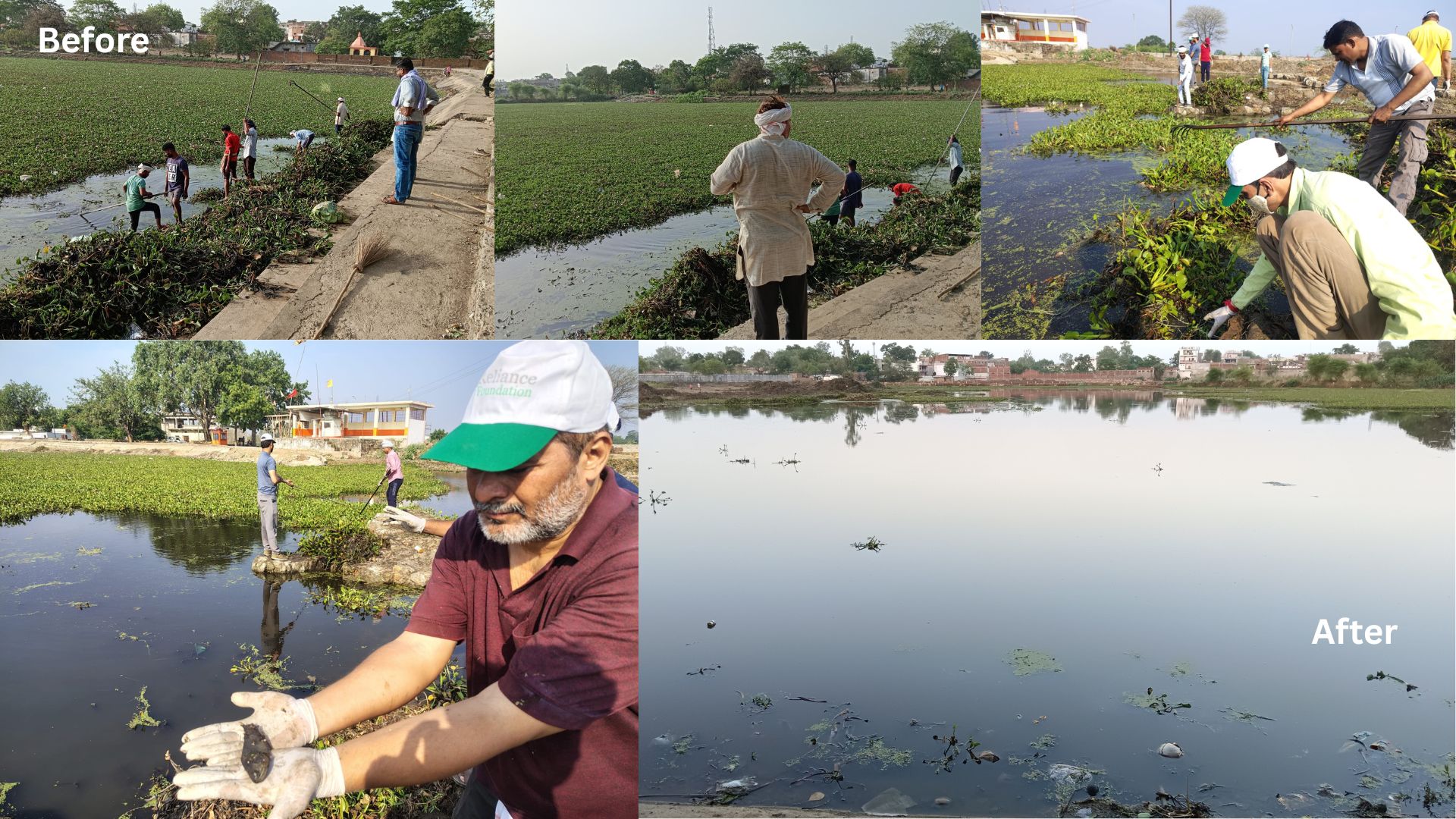
Yet over time, neglect by the administration, the local government and citizens alike allowed water hyacinth to take over the lake. The invasive weed spread across the surface, starved the water of oxygen, and began killing off the fish, plants and other life the lake had sustained for two centuries. A heritage water body was slowly being smothered in plain sight.
A handful of volunteers, then a movement
A fortnight before World Environment Day, a team of civil society organisations decided to act. It began modestly — a few volunteers, some tools, and the will to start. Within days, that small effort had become a genuine movement.
Sensitive government officials, CSR groups, the media, and individuals from across the town joined hands. Samarthan team worked as a catalyst to bring every one together.The work was hard and almost entirely manual: more than 60 trollies of hyacinth were pulled out of the lake by hand, each load weighing eight to ten quintals. What stood out was who showed up. The District Collector herself rolled up her sleeves, took part in the clean-up, and motivated other officials to follow — a reminder of how much a credible leader can shift the energy of a public effort.
Today, the lake is free of hyacinth. The water can breathe again, and the civic action has measurably improved the health of a pond that now has every chance of thriving well beyond its second century.
From a clean-up to a long-term commitment
The most encouraging part of the story is that the effort did not stop once the weed was gone. A one-time clean-up is easy to celebrate and easy to forget; what Panna is attempting is harder and far more valuable — keeping the lake healthy for the long term.
The municipal body has agreed for constructing toilets and repairing the lake's boundary. The revenue department is taking on the difficult task of addressing encroachment in and around the water body. And to give the lake a more dignified place in the town's life, plans are underway for a park, a walking track and other recreational facilities, so that residents have a reason to value, visit and protect it.
The question Panna leaves us with
If the story ended here, it would be a feel-good account of a town that came together. But it raises an uncomfortable question worth sitting with: why don't such actions happen naturally — before a crisis — in the thousands of towns and cities living beside neglected lakes, rivers, parks and other common properties?
There is no single answer, but the possibilities are revealing. Perhaps elected representatives in our local bodies have never been properly oriented to their roles and responsibilities. Perhaps local governments have drifted away from the very citizens who elect them. Or perhaps people have quietly concluded that these institutions exist mainly to deliver state and central government schemes, rather than to respond to local needs. It is telling that ward members are far less visible in their wards than MLAs are in their constituencies.
The irony is sharp. Our towns are rich in natural assets — lakes, ponds, parks, forests — that could generate real value if they were protected, maintained and designed for genuine public use. Instead, ideas meant to bring governance closer to people, like the Mohalla Sabha or resident welfare associations, have largely stayed on paper. There has been little push from local or state governments to make them real, partly because doing so means more work and more upward accountability. And many of the issues that matter most — sewerage, drains, forests, shared commons — spill beyond the boundary of any single ward and need planning at the zonal level, with several ward representatives at the table.
Where the solutions lie
This can feel like a chicken-and-egg problem, but the way forward is not a mystery. A few practical shifts would go a long way:
- Decide budgets in the open. Ward funds parked with the ward members ( Parshads )should be allocated in large public meetings, with priorities that cannot be quietly changed without consulting citizens.
- Make performance visible. Every Parshad could share a performance report in a public meeting, with citizens' feedback taken seriously rather than noted and shelved. Town Hall culture should be revised or nurtured. There are several halls/meeting venues available in several colonies that can be the meeting points.
- Use technology to hold power accountable. Public digital platforms can make both the administration and elected representatives answerable in ways that are hard to ignore. Several technological innovations to connect citizens with the service providers fail to deliver because the performance of such platforms is never discussed and shared with the citizens.
- Fix the structural inefficiencies. Municipalities and Gram Panchayats are chronically short of staff, rarely receive serious capacity-building support, and often see multiple agencies doing similar, overlapping work in the same city. These problems are structural, and they need structural solutions.
None of this is possible, though, without the one ingredient that is hardest to manufacture: political will. Strengthening local governments means the union and the state must be willing to let go of some concentration of power and resources. That is a real risk for those at the top — but a risk worth taking. Deliberately devolving power downward would not weaken our democracy; it would deepen its roots, and give citizens a far greater stake in improving the environment they actually live in.
The takeaway
Maharaj Sagar shows what is possible when citizens, officials and civil society decide that a shared asset is worth fighting for. The lake is breathing again because people chose action over speeches. The real test now is whether we can build the kind of responsive, accountable local governance that makes such revivals the norm rather than the exception — so that the next lake doesn't have to nearly die before its town comes to its rescue.
Samarthan – Centre for Development Support works across Madhya Pradesh and Chhattisgarh to strengthen local governance, water security and citizen participation. The revival of Maharaj Sagar is exactly the kind of citizen-led, locally-rooted change we believe our towns are capable of.